
Magazine Artificial Intelligence
Energy for AI Data Centers: Three Mile Island Returns to Power AI
Three Mile Island reopens to power AI data centers: local impact, waste concerns, and Big Tech's role in building infrastructure.
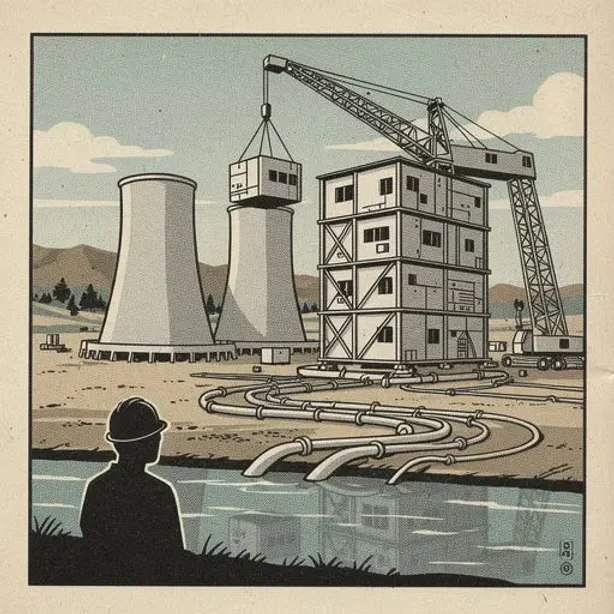
Energy for AI data centers is today one of the most decisive issues for major tech companies and energy infrastructure: Three Mile Island sits at the center of this knot. A twenty-year agreement between Constellation Energy and Microsoft provides that Microsoft will buy 100% of the energy produced by a reactivated plant to power its data centers.
Why energy for AI data centers has become strategic
The electricity demand of data centers is rising with the widespread adoption of AI services and cloud infrastructure; companies like Microsoft seek stable, low-emission supplies to support intensive energy loads.
The site: Three Mile Island and the memory of 1979
Three Mile Island is known for the nuclear incident on March 28, 1979, which remains the worst in the U.S. and has shaped the nuclear debate for decades; the reopening concerns Unit 1, shut for economic reasons and expected to return online in 2028, while Unit 2 has been offline since 1979.
The health consequences of the incident remain controversial: official studies have ruled out deaths directly attributable, but local groups report increases in cancer.
The new project: Crane Clean Energy Center and the Microsoft deal
The facility set to reopen has been renamed Crane Clean Energy Center; Microsoft has signed an exclusive twenty-year agreement with Constellation Energy to secure all the energy produced.
What the agreement means for the region
According to local opponents, the model is that of a plant serving data centers rather than nearby communities: residents provide resources (water, labor) and live with the risks, but do not receive direct electricity.
Eric Epstein, founder of Three Mile Island Alert, summarizes the concern: It’s a zombie plant: it will not serve homes or local activities, but the interests of Big Tech.
The main criticism: without a national waste repository, waste risks staying stored locally for a long time.
Waste and fuel management: operational critical points
After the 1979 incident, the melted core of Unit 2 was moved to the Idaho National Laboratory; today the central issue is the management of spent fuel that would first be cooled in pools and then moved into dry cask containers on site.
Why on-site storage is worrying
Without a national geological repository in the United States, on-site storage could turn the island into a kind of permanent nuclear dump: residents fear long-term risks related to safety, transport, and environmental responsibility.
Regulatory implications: the Nuclear Regulatory Commission
The process to restart a decommissioned plant is complex and passes through the Nuclear Regulatory Commission; at present the NRC has not yet issued the final approval for the Three Mile Island reopening.
Factors influencing the permit
Regulatory assessments consider operational safety, spent fuel management plan, impact on the population and emergency procedures; the rising urbanization around the site and the presence of critical facilities complicate the risk picture.
The political context and pushes in favor of nuclear power
In recent years the federal administration has shown interest in supporting the restart of nuclear plants, including public funding; the cited example is the $1.5 billion loan to the Palisades Nuclear Plant in Michigan to facilitate its reopening.
Similar deals involve big tech companies: Google signed with NextEra Energy to restart the Duane Arnold plant in 2029, signaling that Big Tech seeks dedicated and low-emission energy sources.
Economic impact and real demand for data centers
For Microsoft, securing long-term energy means stabilizing costs and ensuring capacity for data centers powering cloud services and AI models; for local communities the economic impact may be limited and fragmented, raising tensions over the real value of the local investment.
Who really benefits
The companies running data centers gain energy reliability and sustainability credentials, while residents expect local jobs and benefits: the mismatch between corporate benefits and social costs is at the heart of the political and civic conflict.
Alternative scenarios and technological options
There are alternatives to nuclear power to support AI demand, such as improving data center energy efficiency, combining renewables and storage, or dedicated microgrids; the choice depends on costs, speed of implementation, and territorial constraints.
Operationally, the modularity of data centers and load optimization can reduce part of peak demand, but large-scale AI operations still require stable and programmable supplies at scale.
Critical analysis: pros and cons of the operation
Pros: energy security for critical AI services, reduced emissions if the plant replaces fossil fuels, potential local investments; these advantages must be weighed against risks of waste storage, social opposition and regulatory uncertainty.
Cons: risk of creating infrastructure that mainly serves Big Tech, possible on-site waste permanence, and the fact that economic benefits for residents are not guaranteed; transparency of agreements and local governance mechanisms are decisive in evaluating the project’s equity.
A balanced assessment requires weighing the growing demand for AI energy against less controversial alternatives and a national nuclear waste plan: without a national repository, local solutions remain partial and potentially problematic in the long term.
Practical guidance for founders and data center operators
If you manage or develop cloud and AI infrastructure, assess energy supply chain risks, diversify sources, and plan for political and regulatory risk scenarios; long-term supply contracts with dedicated plants reduce uncertainty but may transfer social responsibilities not directly visible in the operating budget.
Operational check-list
- Assess energy provenance and supply clauses; 2) Check waste management plans and responsibilities; 3) Consider reputational and social impacts; an energy due diligence should include emergency plans, backup options and consultation with local communities.
Final reflections: what to watch in the next moves
Follow the evolution of NRC approvals, local community counterarguments and changes to waste storage plans; if the deal is approved, it will be a case study for how Big Tech and the energy sector redesign infrastructure for AI.
In summary, Three Mile Island highlights a growing tension between the need for programmable energy for AI and the demand for sustainable and socially acceptable solutions: the decision is not only technical but deeply political and social.
Related articles
-
Scaleway adds AMD supercomputer and Nvidia GPUs in Nordics
Scaleway will open a Copenhagen GPU Zone with thousands of Nvidia GPUs for AI training and inference, alongside an AMD supercomputer in Sweden.
-

Meta's Muse AI agent accelerates the race for autonomous software
Meta launched its Muse AI agent on September 8. The app has since passed 6.6 million downloads, speeding up the race against OpenAI and Instinct.
-

OPPO to bring Manus agentic AI to Find X10 with Agent Mode
OPPO and Manus will bring agentic AI to the Find X10 series with ColorOS 17, via AI Mind Pilot's new Agent Mode, debuting at launch.
-

Artificial Intelligence: Choosing Chips, Power and Political Strategy
Access to power is one of the factors that define the adoption of artificial intelligence.