
Magazine Policy & EU Innovation
European Strategies: AI, Batteries, and Sustainable Cities
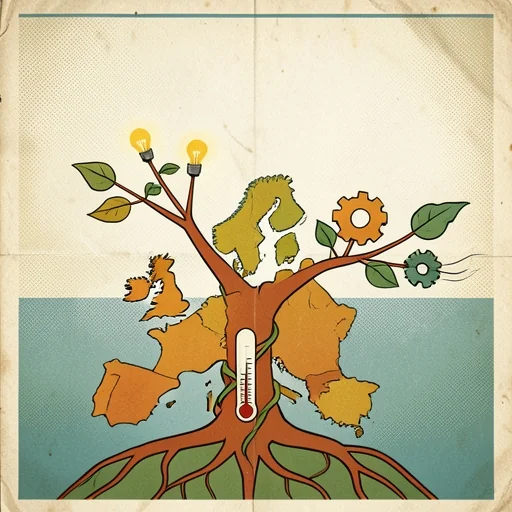
European strategies actively shape a future combining environmental sustainability, technological autonomy, and scientific progress. Europe faces an epochal transition, redefining strategic priorities. This transformation has a dual imperative. It addresses the climate crisis with innovative solutions. It also strengthens technological autonomy in key sectors. These interconnected challenges catalyze ambitious initiatives. Projects range from sustainable urban regeneration to Antarctic research. They include next-generation AI infrastructures and a European supply chain for electric vehicle batteries.
These efforts are not isolated. They are facets of a single integrated vision for a more resilient and autonomous continent. Future leadership depends on investing in deep research. It also requires developing strategic industrial capabilities. Creating livable and responsible urban environments is key. For founders, operators, and investors, understanding these initiatives offers a valuable map. This map indicates opportunities and directions for future innovation.
European policies aim to create an integrated and sustainable innovation ecosystem.
Piedmont Invests in Sustainable Mobility and Urban Regeneration
The Piedmont Region allocated 30 million euros in the FESR Regional Program. The “Regenerative Cities” call transforms public spaces. It also improves air quality in Piedmontese municipalities. The initiative promotes active mobility, like walking and cycling, near major urban centers. The application window opened on July 30, 2026. A race has begun to access these valuable funds.
Eligible municipalities are in specific air quality zones. These include “Turin Agglomeration” (IT0118), “Plain” (IT0119), and “Hill” (IT0120). Each entity can submit only one project. The minimum eligible investment is 250,000 euros. Grants are non-repayable contributions. They can cover up to 90% of eligible costs. Maximum limits vary by municipality size. Municipalities under 10,000 inhabitants have a cap of 630,000 euros. Provincial capitals and municipalities over 10,000 inhabitants can access up to 1,800,000 euros. This applies if they limit polluting vehicle circulation. The evaluation is “first-come, first-served,” by submission order. A quick, well-structured application is essential by October 30, 2026.
Antarctic Research at the Heart of Earth System Studies
The National Research Program in Antarctica (PNRA) opened the PNRA 2026 Call. It is available from September 10 to October 8, 2026. The call funds projects deepening knowledge of Antarctica and Earth system interactions. Its primary objective is to improve understanding of complex interactions. These include the cryosphere, hydrosphere, atmosphere, biosphere, and lithosphere. This scientific commitment is crucial for monitoring global climate change. Antarctica holds a unique position as a climate sensor and regulator.
Proposals must align with the triennial PNRA 2024-2026 and focus on priority areas. These areas include Earth-Ice-Climate interactions, the Antarctic ocean, lithosphere, and atmosphere. Research also covers life in Antarctica. It focuses on evolution, adaptation, biodiversity, and biocoenosis. Other fields include astronomy, astrophysics, space weather, and anthropogenic impact. Environmental contamination, biomedicine, psychology, and technology are also covered. The 2026 edition introduces a line for projects in the Southern Ocean. These projects will be aboard the polar research vessel Laura Bassi. This highlights oceanographic research’s importance for global mechanisms.
European Strategies for Artificial Intelligence Gigafactories
The European Commission launched a call for proposals. It aims to build up to seven “AI Gigafactories” in Europe. The strategic objective is to strengthen technological sovereignty. It also positions Europe among AI leaders. Public investment can reach up to 10 billion euros. The aim is to activate at least 20 billion euros of private investment. This totals over 30 billion euros. These infrastructures will provide advanced computational resources. They will be used for training, inference, and fine-tuning AI models.
AI Gigafactories will integrate latest-generation processors, software, and cloud stacks. They will also have high-speed connectivity and efficient data centers. They will operate in synergy with Europe’s 19 existing AI Factories. Consortia or Special Purpose Vehicles (SPVs) must unite businesses, public bodies, investors, and partners. Facilities can be in a single Member State, across multiple sites, or distributed. Funding will be managed by the EuroHPC Joint Undertaking and Member States. The procedure involves two lots and two development phases. First lot projects can receive up to 100 million euros in phase one. They can get 400 million in phase two. The second lot, for higher capacities, can obtain up to 200 million in phase one. They can get 800 million in phase two. The initiative includes supplier agreements for technology access. The application deadline is November 12, 2026.
AI Gigafactories will be key infrastructures for European digital sovereignty.
Strengthening European Electric Vehicle Battery Production
The Commission opened the first call for the Battery Booster Facility. This instrument is part of the Battery Booster Strategy. It has 1.5 billion euros available. The objective is to strengthen European battery production capacity. It aims to support a resilient industrial supply chain for electric vehicle cells. This covers the European Economic Area (EEA). The EEA includes EU Member States and three EFTA States. This initiative is crucial for the energy transition. It also boosts the competitiveness of the European automotive industry.
The call funds projects in the “ramp-up” phase via zero-interest loans. The goal is to increase production capacity. It also aims to attract private investment and accelerate industrial development. Projects must involve electric vehicle battery cell production. They must be the proponent’s first commercial-scale production project. A minimum annual production capacity of 10 Gigawatt-hours (GWh) is required. Funds come from the Innovation Fund. This fund is powered by the European Emissions Trading System (EU ETS). Selected projects can get a loan up to 60% of eligible costs. This can be up to 500,000,000 euros per project. Applications are evaluated for technical and financial maturity. Their contribution to the European battery ecosystem is also assessed. The deadline for proposals is September 30, 2026.
The push for sustainable mobility in Piedmontese cities connects with European battery production ambitions. Investments in cycling and pedestrian infrastructures reduce urban emissions. Local cell production offers strategic advantages. It reduces dependence on external supply chains. It also stimulates demand for electric vehicles. This contributes to emission reduction targets for Piedmont’s “Regenerative Cities.” The synergy between industrial development and local interventions shows an integrated ecosystem.
The main challenge is coordinating these efforts. It also involves attracting private capital to scale solutions. Advanced computing infrastructures must support supply chain optimization and management. AI Gigafactories must support materials research and urban logistics. Without coordination and private investment, commercial scale risks remaining limited.
European initiatives depict a determined continent. These range from polar research to AI infrastructures. They also cover battery production and urban regeneration. Available public funding exceeds 40 billion euros across various calls. This indicates a strong political and strategic commitment from the European Union. Program success depends on capital availability. It also requires attracting the best talent. Stimulating public-private collaboration is necessary. Navigating bureaucratic and logistical complexities of large-scale projects is essential.
These opportunities represent fertile ground for founders and innovators. Demand for solutions in sustainability, energy efficiency, AI, and scientific research is growing rapidly. For startups, identifying calls for proposals is crucial. Understanding how initiatives intertwine is also important. These initiatives create new market niches and unexpected synergies. Europe invests to build a green and digitally advanced future. Those who seize the opportunity can lead this epochal transformation.
Outlook and Next Steps
Stakeholders must consolidate effective public-private partnerships. This aligns investments, expertise, and governance to scale projects. Local administrations must prepare concrete and timely proposals. Industrial promoters must demonstrate technical maturity and solid financial plans. Private investors must be involved from the earliest stages. This transforms public capital into real territorial impact.
Sources:
- PR FESR 2021-2027: Al via le domande per il Bando ‘Città Rigenerative’ | europainnovazione.com
- PNRA 2026: pubblicato il bando per progetti di ricerca in Antartide | europainnovazione.com
- AI Gigafactories: al via il bando UE per realizzare fino a sette… | europainnovazione.com
- Battery Booster Facility: aperta la call da 1,5 miliardi di euro… | europainnovazione.com
Related articles
-

European funding calls for cross-sector consortia using digital twins
European funding calls require transnational consortia and concrete multisector approaches.
-

Ukrainian culture funding: four EU calls to build lasting partnerships
Each call is designed to respond to a different need: mobility, professional insertion, memory preservation and direct collaboration with Ukrainian culture.
-

Technological Sovereignty: Lessons from Boeing and Palantir
In Europe, the challenge of regaining technological sovereignty in the face of Palantir is complex.
-

Regional funding calls for prototypes, scale-ups and equity
Regional funding calls can bridge the gap between the laboratory and the market.