
Magazine Artificial Intelligence
Artificial intelligence in construction and insurance operations
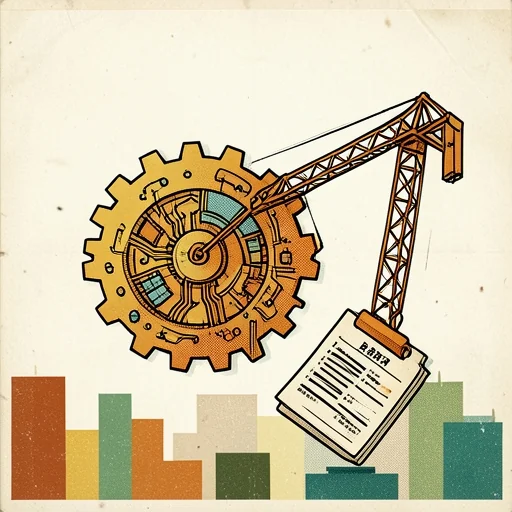
The technological landscape is constantly evolving. The adoption of artificial intelligence (AI) is one of the most significant changes. These are not superficial applications. It is a deep integration that transforms traditional industries. Insurance and construction are examples. Companies such as adesso, which acquired omni:us, and Trunk Tools, founded by Sarah Buchner, demonstrate this trend. Artificial intelligence is becoming a central component for tackling complex challenges. It also unlocks new efficiencies.
Fragmented Data and the Opportunity of Artificial Intelligence
Construction and insurance are different sectors. Both generate a huge volume of fragmented and unstructured data. An average construction site can produce 3–4 million pages of documentation. These are scattered across many systems. Sarah Buchner, founder of Trunk Tools, saw an opportunity in this disorganization. Her experience as a carpenter showed her a limitation. Traditional analysis was insufficient for complex, unstructured data.
Also in the insurance sector, claims handling is complex. It requires analysis of a lot of information from different documents. omni:us, founded in 2015, developed artificial intelligence solutions for end-to-end automation. Its technology analyzes claims. It applies specific insurance logic. It generates traceable outputs that can be integrated into core systems. adesso acquired omni:us. adesso is a leading provider in Germany. It had revenue of €1.3 billion in 2024 and more than 11,100 employees. The acquisition aims to integrate AI for claims processing.
Artificial intelligence is the only tool to untangle the data knot, turning it into operational knowledge.
AI as an Intrinsic Engine of Operational Processes
The real revolution is not adding an AI app. It consists of integrating it deeply. Andreas Nolte of adesso made this clear. AI must connect to systems, data, and controls. These are used by insurance companies. The integration of omni:us into adesso’s in|sure Ecosphere platform is an example. AI becomes a central component of the combined insurance portfolio.
Trunk Tools integrates its AI with construction companies’ systems. It creates a higher layer to analyze and automate. AI agents review contracts and technical drawings. They flag inconsistencies. They assist in managing specifications and bids. The ability to link information across the entire project is crucial. The human mind cannot compute the cascading effects of changes. An AI agent calculated that a change would have added nearly $4 million to a project. That convinced the client not to proceed.
Industry Knowledge in the Service of Innovation
The success of AI depends on understanding the industry. Sarah Buchner is an example. She has a decade of experience as a carpenter and contractor. She founded Trunk Tools in 2021. A fatal incident on a construction site pushed her to seek solutions. She earned a doctorate in data science and artificial intelligence. Her blue-collar perspective is a unique advantage. She developed products that address real needs in the field. An AI agent provided immediate instructions for a chemical exposure. This safeguarded an employee’s health.
In the insurance sector, the credibility of AI is crucial. It must operate under real financial, regulatory, and operational conditions. Thomas Hauschild, CEO of omni:us, emphasized this work. The company focused on key requirements. These include explainability and human oversight. They ensured operational reliability, data protection, and information security. Full traceability was fundamental.
The credibility of AI is played out in its ability to operate under real financial, regulatory, and operational conditions.
These aspects overcome the caution of regulated sectors. Construction, with thin margins, adopts new technologies slowly. Trunk Tools raised $70 million. It reached a valuation of $325 million in 2025. It learned that software alone is not enough. The company offers training and change management. This helps implement AI in large organizations. Direct experience and trust are key ingredients for adoption.
AI is crossing technological boundaries. It takes root in the operational fabric of complex industries. Translating field experience into AI solutions is essential. This, combined with deep integration and attention to regulation, opens a new era. It brings efficiency and safety. For founders and innovators, there is a clear lesson. True innovation is not just technology. It lies in targeted application to solve real problems. It requires an authentic understanding of the operational context. This approach is fundamental to unlocking the full potential of artificial intelligence.
Sources:
Related articles
-

Artificial Intelligence: Choosing Chips, Power and Political Strategy
Access to power is one of the factors that define the adoption of artificial intelligence.
-
Artificial intelligence turns cultural events and supply chains into products
Five concrete cases show how artificial intelligence works today as a practical lever.
-
Quando l'intelligenza artificiale sostiene reti e competenze
Intelligenza artificiale: The adoption of artificial intelligence is changing infrastructure, skills and products in companies.
-
Artificial intelligence for cities, infrastructure and investor strategies
Artificial intelligence acts as a lever to transform resources, trust and services. Large technological transitions rarely happen in a single sector.