
Magazine Sustainability & Green Tech
Battery Recycling in Europe: tozero Opens a Demonstration-Scale Industrial Plant
In Bavaria, tozero opens a demonstration plant that recovers lithium and graphite from end-of-life batteries with an acid-free industrial process.
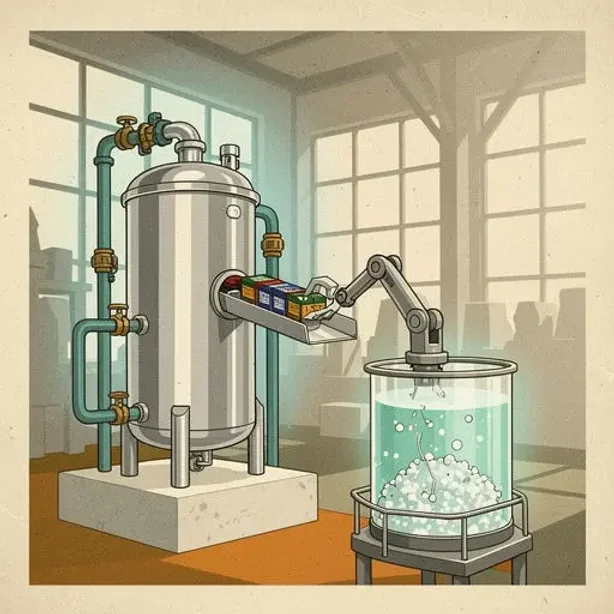
Battery recycling in Europe is now a demonstrable reality: tozero, a women-founded Munich-based startup, has launched its first demonstration-scale industrial plant in Bavaria to transform end-of-life batteries into reusable raw materials.
Battery recycling in Europe: plant and operating capacity
The plant is located at the Chemical Park Gendorf in Bavaria and was built in just six months, a timeline that confirms the speed of industrial execution.
The plant can process over 1,500 tonnes of battery waste per year and produce about 100 tonnes of high-purity lithium carbonate annually.
The ability to produce 100 tonnes of lithium carbonate per year equates to preventing the materials contained in batteries equivalent to about 10,000 electric vehicles from ending up in a landfill.
How the process works and what it recovers
tozero uses a proprietary acid-free hydrometallurgy process that, according to the company, enables treatment in a single cycle and yields materials with purity sufficient to return directly to the production of cells and cathodes.
The acid-free process at tozero enables the industrial recovery of lithium, graphite, and nickel-cobalt blends with quality suitable for the battery supply chain.
A single, acid-free cycle reduces chemical waste streams and simplifies reconverting the materials into the battery production process.
Concrete figures and industrial goals
The demo will serve as a model for a future full-scale commercial operation planned for 2030: tozero aims to process 45,000 tonnes of batteries and to produce 8,000 tonnes of lithium carbonate and about 10,000 tonnes of graphite per year.
The scale-up plan envisions moving from the demo plant to a commercial capacity capable of meeting a portion of Europe’s demand for battery raw materials.
Why it matters for startups and the supply chain
The issue of raw material sovereignty is central to the battery industry: Europe is heavily dependent on imports (estimates suggest 99% of the EU’s lithium comes from abroad, and global graphite production is largely centered in China).
Recovering materials from end-of-life batteries is a strategic lever to reduce import dependence and build a European circular supply chain.
Validations, partnerships and results achieved
tozero says it has already qualified recycled lithium and graphite for use in industrial batteries and, in 2024, became the first in Europe to supply recycled lithium to commercial customers; it also collaborates with OEMs such as BMW and MAN.
In pilot projects, the startup has achieved lithium recovery yields above 80%, surpassing the European targets set for 2031.
In February 2025, tozero announced it had qualified 100% recycled graphite for industrial-scale cell production, a significant milestone for battery anodes.
Market context and regulation
Global lithium demand is expected to grow strongly (some estimates indicate it could double or quadruple by 2030) and demand for graphite in the EU could rise up to 25-fold by 2040: numbers that make recycling strategic.
The European Union has positioned recycling as a lever of industrial policy: the Critical Raw Materials Act aims to deliver 25% of supply from recycled sources.
Critical analysis: risks, opportunities, and cautions
The tozero case demonstrates a mix of real opportunities and concrete challenges: on one hand, access to domestic material stocks and reduced transport impact from imports; on the other, the need to guarantee steady feedstock volumes, quality standards, certifications, and economic competitiveness relative to virgin minerals.
The availability of end-of-life batteries and the quality of the collected material will be key determinants of the economic sustainability of large-scale recycling plants.
Pros include: reduced strategic dependence, a smaller environmental footprint than primary extraction, and the potential for lower costs in a closed-loop supply chain. Cons include: collection and logistics of battery waste, variations in cell chemistry that require adaptable processes, and the need for quality standards accepted by cell manufacturers and OEMs.
A critical point is certification and the confidence of cell manufacturers: without reproducible evidence of quality and continuity, recycled material will struggle to achieve significant market shares.
For leaders of a green startup or those working along the battery value chain, the practical implications are clear: integrate supply activities (collection and assessment of waste), invest in material qualification, and build partnerships with cell manufacturers and OEMs to create recognized demand for recycled materials.
Next steps and operational recommendations
To scale, projects like tozero’s will need to secure end-of-life battery supply contracts, obtain recognized certifications, and demonstrate cost competitiveness with virgin materials.
Startups should prioritize material traceability, standardization of specifications, and partnerships with manufacturers and distributors to accelerate demand for recycled materials.
Expected impact and roadmap
tozero states that the demo plant will serve as a blueprint for a commercial facility in 2030 with much greater capacity: a roadmap that, if replicated, could contribute to Europe’s recycling targets and create a domestic market for critical raw materials.
The model’s replicability and speed of deployment will be the key variables in turning demonstration projects into a true European circular supply chain.
An opportunity for innovators and investors
The shift toward a circular battery value chain opens room for complementary technologies (smart collection, sorting, logistics, digital certification, reuse-ready materials) and integrated business models across the entire chain.
Investors and founders should assess not only the treatment technology but also the logistics network and industrial partnerships that ensure volumes and commercial adoption.
Toward a more autonomous European supply chain
Ultimately, the tozero project is a concrete example of how recycling can move from the lab to industry, offering opportunities to reduce dependence on imports and to reintroduce critical materials into the European production cycle.
If the model proves replicable, battery recycling in Europe could become a stable source of raw materials and a strategic lever for the battery industry.
To accelerate the transition, a combination of technological innovation, policies that support demand, and investments in collection and material qualification infrastructure are needed.
Original source and further insights on tozero and the demo plant: link at the bottom of the article.
Related articles
-

Sustainable Innovation Across Agriculture, Health and Territory
Targeted investments strengthen regional attractiveness and can generate a cascading impact.
-

How to make self-produced energy investable
Storage systems must absorb at least 75% of the energy produced by the connected plant, a condition that favors integrated production-and-storage projects.
-

Sustainability and Community as a Product: Strategies for Impact
Campaigns that link product and social value shift attention from ownership to collective action.
-
Kylian Mbappé joins On and the rise of verified carbon accounting
At the same time the market for carbon accounting software is exploding because regulators demand verifiable numbers.