
Magazine Sustainability & Green Tech
Energy Transition in Europe: Crisis, Opportunities and Lessons for Cleantech
The European energy transition is being reexamined by the Iranian shock: impacts on prices, cleantech investments and design.
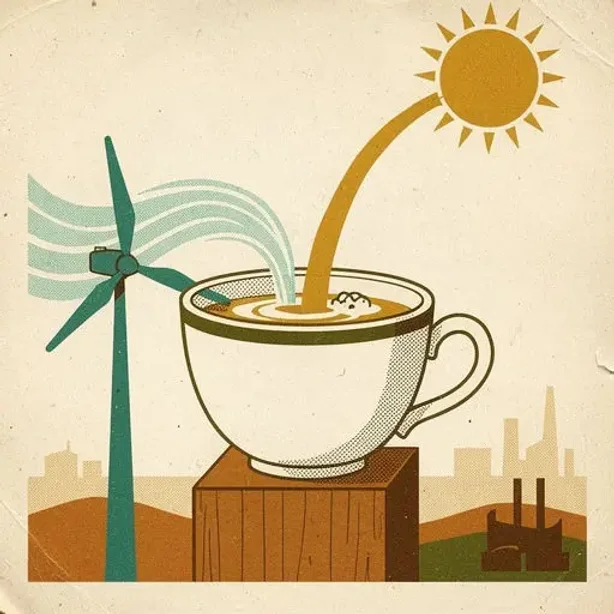
The energy transition in Europe is being tested by the war in Iran, which has unleashed a new shock to gas prices and brought into focus a design issue in the electricity market.
How the energy transition in Europe clashes with marginal pricing
The metaphor used by Ember researchers is clear: the hourly demand of a country is a cup that fills from the cheapest sources to the most expensive; the price is set by the last portion needed to fill it. If filling the last centimeter of the cup requires gas, the price for the entire hour aligns with the cost of gas.
It’s not the share of fossil energy in the mix that matters so much, but how often that technology acts as the price-setter. A residual fossil share can fully transmit geopolitical shocks to final prices, erasing the benefits of renewable investments.
The operating rule: the hourly price is determined by the marginal source; reducing gas price-setting hours is more effective than simply reducing the absolute fossil share.
Energy transition in Europe: the Spain case and key figures
Spain has become a benchmark: in 2021 gas set wholesale prices in 52% of hours; by 2025 that share fell to 26% thanks to the massive expansion of solar. In the first half of 2025, the average wholesale price in Spain was about two-thirds the EU average, according to Ember.
Today over 40% of Spain’s electricity comes from solar and wind, but this success required investments in grid services such as synthetic inertia, storage and frequency control. A high-renewable-penetration system works only with adequate grid and storage infrastructure.
Energy transition in Europe: the German paradox and Italy’s exposure
Despite Germany having more absolute renewable capacity than Spain, in 2025 gas dictated prices in about 35% of hours, a share even worse than in 2021. The nuclear phase-out and the partial underperformance of coal have increased dependence on gas for base load.
For Italy the picture is even more critical: gas accounts for almost half of the electricity mix and, after the Iranian escalation, Italian wholesale prices spiked. Italy remains among Europe’s most exposed countries to geopolitical shocks on gas and oil.
Practical takeaway: to reduce volatility and commercial risk, intervention is needed both on the source (renewables + storage) and on the market architecture that sets prices.
Energy transition in Europe: what changes for investors and startups
The shock has three operational implications for those investing in energy innovation. First: cleantech hardware is becoming attractive again to value-driven capital, with focus on long-duration storage, alternative batteries (iron-air, sodium-ion), electrolysers and grid components.
Second, energy software becomes strategic: weather forecasting, VPP, demand response, algorithmic trading systems for SMEs, and managing distributed storage fleets are segments where European VC can compete without the high capex of utility-scale. Software lowers the entry barrier and can scale cross-border more easily.
Operational opportunity: software-energy startups can offer services that increase revenue predictability and reduce price risk for industrial customers.
Third, the nuclear debate has returned to the center: attention to SMR (small modular reactors) has grown and some VC funds have started evaluating related projects. Interest in modular nuclear solutions reflects a desire to reduce dependence on marginal gas.
Market reforms and policy tools
Brussels is working on two decisive levers: cross-border interconnections and a revision of market design. A greater level of interconnection can ‘transfer’ renewable surpluses and reduce the number of gas price-setting hours.
According to Agora Energiewende, better system optimization and interconnections could save nearly $600 billion for European citizens between 2035 and 2050. For startups and suppliers this means demand for dispatch software, sensor technology, and OT cybersecurity.
On pricing, the widespread use of long-term contracts and contracts for difference for renewables decouples revenues from day-to-day wholesale price movements. The widespread adoption of CfD would make margins more predictable and reduce the cost of capital for new plants.
Barriers and opportunities specific to Italy
Italy could benefit greatly from rapid renewable expansion combined with storage, but the regulatory framework remains a brake: permitting, regional authorizations, capacity market rules, and connection rules are real obstacles. Italian startups will often need to demonstrate cross-border execution capabilities to attract international capital.
For Italian energy software scale-ups, this is a competitive advantage: a relatively mature software fabric can fill the gap left by many energy infrastructure startups. Focusing on solutions that can be replicated across multiple jurisdictions is now a winning strategy.
Critical analysis: points of view in comparison
The technical and policy debate on how to accelerate the energy transition in Europe centers on two axes: the effectiveness of renewables alone vs. the need to redesign the market. Proponents of the ‘megawatt first’ approach argue that increasing installed capacity will naturally reduce the share of gas; critics respond that without changing the price-determining mechanism, even a cleaner mix will remain vulnerable to gas spikes.
From an investor’s perspective, it’s practical: if price risk remains high, the cost of capital for renewable projects stays high and many investments are not bankable. This pushes funds to favor solutions that mitigate market risk (CfD, PPA, integrated storage) or that offer direct services to companies to reduce energy price volatility.
A second geopolitical note: crises like the Iranian one show that energy security is not only domestic. Industrial policies will need to combine investments in local supply chains (cells, electrolyzers) with market reforms that protect revenues.
Finally, there’s a time trade-off: boosting interconnections and building storage capacity takes years and public spending; in the meantime, financial and contractual instruments can offer immediate relief but do not solve the structural issue. A mixed strategy, combining regulatory reforms, infrastructural investments, and financial incentives, is the most pragmatic.
Operational recommendations for founders and investors
For those founding and scaling an energy startup in Europe, three concrete priorities are: steer the product toward markets with predictable price fundamentals; build cross-border partnerships to bypass local barriers; and embed contractual models in the business to guarantee stable revenues. Focus on long-duration storage, grid software, and solutions that decouple revenues from the spot price.
For VCs, due diligence now must include an assessment of market-design risk: the startup’s country of origin will become a capital-allocation factor, with a preference for ‘Spain-like’ jurisdictions over ‘Germany-Italy-like’ given the same technology.
Towards the next three years of transformation
The war in Iran has reminded Europe that megawatt-scale renewables are not enough if the market remains priced by gas. In the next 24-36 months we will see a reshaping of investment portfolios toward storage, grid software and modular nuclear.
For Italy and other exposed countries, the challenge is to turn a structural vulnerability into an opportunity: speed up permitting and connection rules, promote CfD and invest in grid infrastructure. The time to delay is over: energy resilience today is also a lever of competitiveness for startups.
For innovators: focusing on technologies that reduce exposure to the spot price is the fastest lever to attract capital and industrial customers.
Note on sources and figures
The assessments in this piece draw on analyses from The New York Times (April 10, 2026) and Ember, as well as Agora Energiewende studies cited in the same reports. Key numbers to remember: gas price-setting 52% -> 26% in Spain (2021->2025), Germany ~35% price-setting hours in 2025, potential savings of about $600 billion from better interconnections 2035-2050.
What to do now (action list for founders)
- Validate the revenue model with spot price and CfD scenarios; 2) design cross-border replicable products; 3) prioritize partnerships with utilities and grid operators.
Related articles
-

Sustainability and Community as a Product: Strategies for Impact
Campaigns that link product and social value shift attention from ownership to collective action.
-

Kylian Mbappé joins On and the rise of verified carbon accounting
At the same time the market for carbon accounting software is exploding because regulators demand verifiable numbers.
-
Energy automation: smart homes, silicon anodes and installers
Energy automation is the thread that connects thermostats that learn routines, denser battery materials and new business models.
-
Energy transition: small modular reactors vs local biogas solutions
La energy transition is often framed as a crossroads between large long-term infrastructure and distributed solutions that deliver value today.