
Magazine Sustainability & Green Tech
Cellulose Produced from Captured CO2: Rubi's Challenge for Sustainable Materials
Cellulose produced from captured CO2: Rubi uses enzymes, AI, and modular containers for a low-carbon, scalable textile supply.
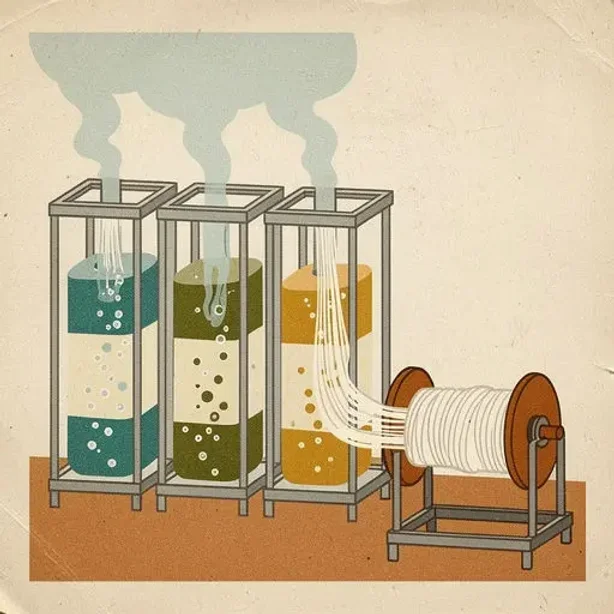
The cellulose produced from captured CO2 enters the debate on sustainable materials as a potential alternative to tree-derived cellulose, proposing a new production pathway for lyocell and viscose. Rubi has raised $7.5 million to build a demonstrator scale of its process and says it has over $60 million in non-binding off-take agreements.
Why CO2-Captured Cellulose Changes the Rules
The textile sector is among the largest generators of waste and climate impact: every second, the equivalent of truckloads of textiles is discarded, and the traditional cellulose supply chain relies heavily on forests and complex logistics networks. Producing cellulose from captured CO2 could reduce pressure on natural resources and shorten supply chains.
Rubi technology: enzymes, AI and modularity
Rubi takes a different path from those who use bacteria or chemical catalysts: it employs an enzymatic cascade that converts CO2 into cellulose building blocks, with enzymes operating in aqueous solution and producing white-clean fibers in minutes under lab conditions. The use of enzymes makes it possible to leverage existing industrial capacity in the enzyme industry and offers more competitive cost prospects.
Enzymatic optimization with AI
To make the enzymes effective and scalable, Rubi applies artificial intelligence and machine learning tools to improve activities such as enzyme selection, optimization, and operational stability in the cascade. The integration of applied biology and computational optimization is a key element for moving from proof of concept to industrial repeatability.
The combined enzyme and AI strategy aims to stabilize biological processes so they become reliable and repeatable even outside the lab.
Containerized Modules and Deployment Logic
Rubi’s reactors are designed as container-sized modular units, a choice that facilitates placement near captured CO2 sources or industrial sites and enables potential distributed production. Containerization provides deployment flexibility and the possibility to reduce logistics costs and lead times for the feedstock.
Rubi and CO2-Captured Cellulose: Commercial Model and Validation
Beyond the $7.5 million seed led by AP Ventures and FH One Investments, Rubi has announced non-binding off-take agreements for more than $60 million and has conducted tests with 15 pilot partners, including H&M, Patagonia and Walmart. Piloting with major brands helps validate process compatibility, material performance, and commercial interest before investing in scaled facilities.
Testing with retailers and brands serves a dual purpose: to validate the material in existing processes and to signal market demand that facilitates access to additional capital and industrial partners.
Target Beyond Apparel
While initially focusing on clothing, Rubi’s vision is to become a platform company capable of supplying various low-impact chemicals and materials. A platform positioning opens opportunities for applications beyond fashion, such as technical paper, composite materials and other industrial sectors that use cellulose.
Technical, Economic, and Scale Challenges for CO2-Captured Cellulose
Despite progress, the main barrier remains the shift to continuous, reliable manufacturing with sustainable economics: enzyme stability, energy consumption, costs of input feedstocks and integration with existing supply chains are issues to resolve. Overcoming these obstacles requires technological iterations, extensive pilot testing and investments in demonstrator plants that prove competitive cost per ton.
Scale proof is the true proving ground for every climate tech: replicability, costs and integration into the supply chain determine whether the technology can become industrial.
Discussion Paragraph: Pros, Cons, and Scenarios for Innovators
On the one hand, Rubi’s proposal represents an innovative approach to reducing dependence on forest-derived cellulose and creating low-carbon materials directly upstream in the supply chain: this can cut indirect emissions, reduce deforestation and start more localized production networks. If the technology shows competitive costs and process stability, it could shift investments and contracts toward new players in the bioeconomy. On the other hand, there are non-trivial risks: overall sustainability depends on the energy source used in the process, on the impact of producing cofactors or chemical supports, and on the real ability to replace significant volumes of traditional cellulose. Furthermore, the fashion market weighs not only carbon footprint but also aesthetic, sensory and compostability performance; an alternative material must therefore demonstrate equivalence or superiority on these fronts. For founders and VCs, the Rubi case requires evaluating multiple metrics — LCA (Life Cycle Assessment), cost of goods per ton, time-to-scale and regulatory barriers — and not treating material innovation as mere technical substitution: a go-to-market strategy that involves brands, textile suppliers and logistics distributors is needed to ensure that the new feedstock can be adopted in existing processes. Finally, strategic partnerships (e.g. large retailers or textile groups) can accelerate adoption but require clear contracts on quality, volumes and delivery times, while non-binding agreements, however indicative, do not replace the need for orders with solid economic value.
Implications for Startups and Investors
For those investing in or developing advanced materials, Rubi’s path points to a few practical levers: targeting technologies with pre-existing industrial supply chains (such as the enzyme industry), using AI as an optimization lever, and seeking pilot partners along the entire value chain. A commercial validation strategy with brand testing and off-take agreements, even non-binding, strengthens credibility but should be followed by measurable technical milestones.
Concrete Actions for Founders
If you’re evaluating a similar project, consider these steps: design a preliminary LCA, develop modular, reproducible demos, and negotiate pilots with partners who can validate performance and feedstock integration. The combination of proof of technology, commercial pilots and clear scale-up plans increases the likelihood of commercial success.
A Possible Path for the Future of Materials
Rubi embodies the trend of using applied biology and computational tools to rewrite materials manufacturing, shifting focus from end-of-life recycling to producing low-impact alternative feedstocks. If the startup can demonstrate economy and reliability at scale, it could become a key node in the infrastructure of sustainable materials.
In summary, the cellulose produced from captured CO2 is not yet a mature solution but represents an industrial experiment with potential meaningful implications for sustainability, local supply chains and product design. For innovators and investors, the practical takeaway is clear: evaluate technology, market and scalability in parallel and seek industrial partners early in the project.
Related articles
-

Sustainability and Community as a Product: Strategies for Impact
Campaigns that link product and social value shift attention from ownership to collective action.
-
Kylian Mbappé joins On and the rise of verified carbon accounting
At the same time the market for carbon accounting software is exploding because regulators demand verifiable numbers.
-
Energy automation: smart homes, silicon anodes and installers
Energy automation is the thread that connects thermostats that learn routines, denser battery materials and new business models.
-
Energy transition: small modular reactors vs local biogas solutions
La energy transition is often framed as a crossroads between large long-term infrastructure and distributed solutions that deliver value today.